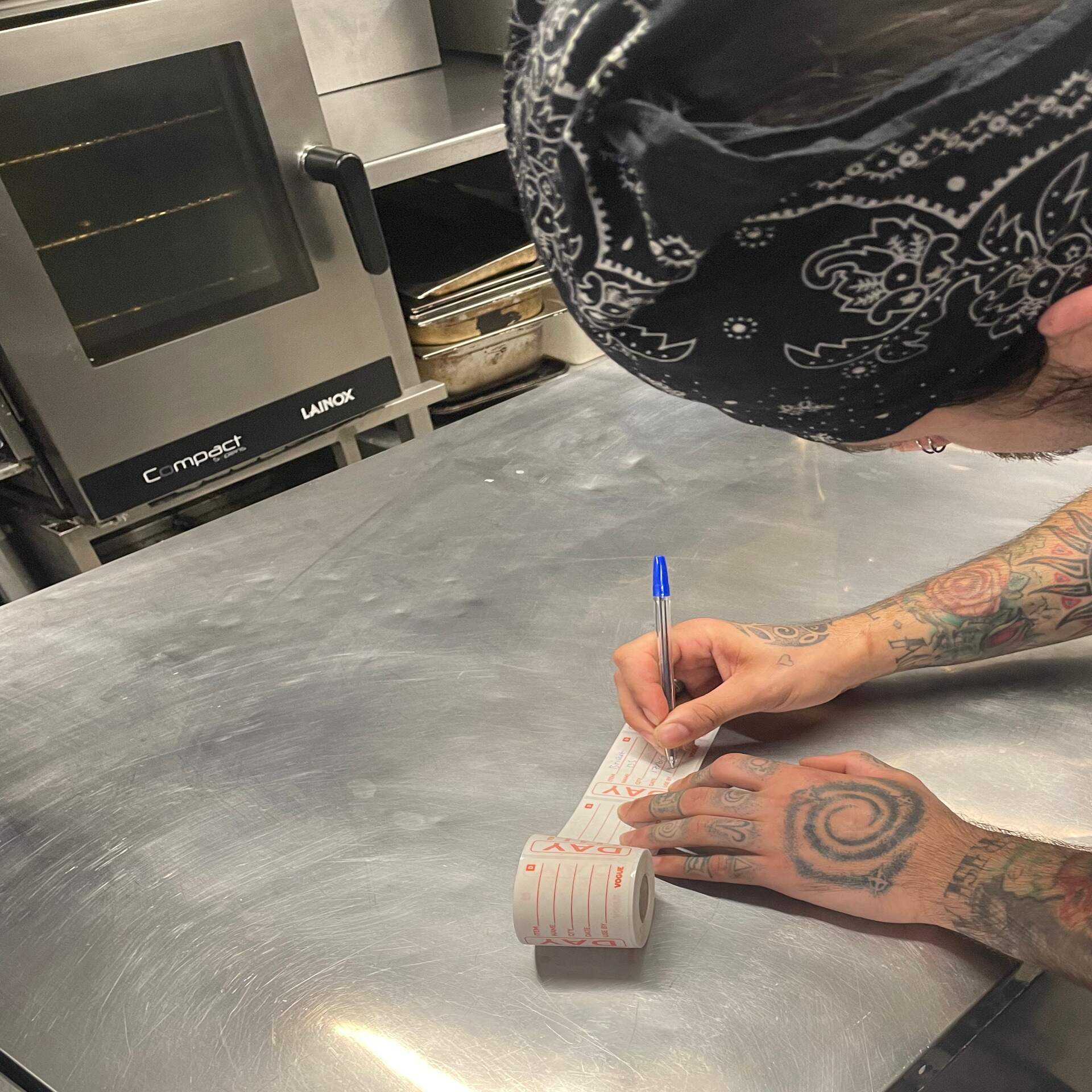
How to transition a multi-site group off handwritten prep labels

A decision to change the prep labelling of a group is usually the result of a specific event. An EHO visit going badly at one site, an allergen near-miss, or a new ops director looking at an estate and realising nobody is confident what is happening across all of their kitchens.
If you’re in the middle of making that decision, the question you're probably asking is which system to switch to. But the question of which system to switch to only matters if you handle the change properly. Groups that pick a decent system and roll it out badly can end up worse off than when they started.
The advice in this article is best suited to estates with 5+ sites.
What a prep label has to carry
A prep label goes on food you've prepared for use in your own kitchen. It needs the product name, the date it was prepped, the use-by date, any allergens, and preferably the initials of whoever prepped the food. When EHOs visit, they’ll check your ingredients are all properly labelled.
Handwriting means someone recalling the shelf life for that product, working out a date, remembering which allergens apply, and writing it legibly, over and over throughout a shift. Although handwritten prep labels are legal, the risk of error is real, and that risk only multiplies across a multi-site group.
Three decisions to make before you look at systems
Who owns your product data?
Name one person to be responsible for updating product information, or put a defined process in place that makes it clear whose responsibility it is each time something changes. This decision determines whether a central system stays accurate, and groups that skip it end up with an expensive way of printing out of date information.
What your standard actually is
Most groups discover during this process that they don't have one written down, or that they have one nobody has read since 2019. Decide what a prep label must contain, and what shelf life applies to what, before you ask a system to enforce it.
Which sites go first
We’ll cover this in more detail below, but it’s important to decide deliberately rather than starting wherever is closest to head office. To truly test a system, think about rolling it out in your busier or larger venues. Alternatively, if you want a lower-risk test, try it in your smallest, lowest volume site and check it works there first.
Getting your product data ready
You'll need a product list with shelf lives and allergens for everything your kitchens prep. Most sites should already have this information, as it is what new staff would be trained on. If your sites run regional variations, you'll need to know which products belong where.
There are three main routes into Labl.it, although it is also possible to use a combination if that is more suitable to your business:
Bulk import: Labl.it takes a CSV or spreadsheet via the back office, so if you already hold product data somewhere, that's usually the fastest way in.
The Menu Analyser tool: It scans a menu and outputs ingredients, foods and allergens in seconds for someone on your team to review and approve before importing.
Manual entry on the device: Slower, but useful for house-made components and one-offs that never made it onto a central list.
This stage has the potential to surface problems you didn’t realise you had, products nobody can give you a shelf life for, recipes that changed years ago, two sites using the same name for different things. All of that is useful information, and far better found like this than during an inspection.
Pilot your hardest site, not your best one
The instinct is to start somewhere strong, a flagship venue, a head chef you trust, a team who'll make it work. In reality, that kind of test tells you almost nothing.
Run your pilot in the site with the highest turnover, the tightest kitchen or the most pressure. If it holds up there, it will hold up across the estate. Labl.it also offers a multi-site trial option, so you can run more than one venue at once. It’s worth doing, because a single site can never truly tell the story of an entire estate.
When a site pushes back
A kitchen that says the process doesn't suit them might have insight into the limitations of a new system that head office doesn’t.
It’s crucial to give sites a route to say it doesn't fit, and then to take the answers seriously. Some of what comes back will be genuine improvements worth adopting across the estate. The rest gives you something concrete to work with, rather than silent non-compliance you discover months later.
What to look for in a system
Does it calculate shelf life by storage method?
Does a central change reach the device?
What does it record without anyone doing anything?
What happens when a device breaks?
Will a new starter be able to use it unaided?
Where Labl.it fits
Labl.it prints EHO prep labels and Natasha's Law PPDS labels from a handheld device, with shelf life calculated according to how each item is stored. Products are held in a central back office and pushed across the whole estate or to selected sites, with permissions set to match your structure.
For a group mid-switch, the most relevant features are the bulk import and Menu Analyser tool for getting products in, the multi-site trial for testing properly before committing, dedicated account management and onboarding support with in-person training where a site needs it, and reporting that covers the entire estate while drilling down to individual venues.
Pricing is per device rather than per site, at £34 monthly or £28 a month on the annual plan (excluding VAT), with bulk and enterprise rates available through our Enterprise Account Executive.
Frequently asked questions
We're a 12-site group with EHO issues from handwritten prep labels. What should we do first?
Name one person to own your product data, and write down what a prep label must contain. Then trial a system in your most difficult site rather than your best one.
How long does it take to switch a multi-site group to digital prep labels?
Individual sites are running within minutes. Across an estate it depends almost entirely on the state of your product data, i.e. how much exists centrally, and how much needs establishing. Your account manager can give you a realistic view once they've seen what you're working with.
Should we roll out to all sites at once?
No. A smaller initial rollout lets you fix problems before they're repeated across the estate, and gather feedback on how well the system fits your business.
Which sites should pilot the new system?
The ones under most pressure: highest turnover, tightest kitchen, busiest service. A flagship venue with a strong team will make almost anything work, which tells you very little.
What if our product specifications are out of date?
Fix them before you switch. A system prints whatever you feed it, so inaccurate specifications will just get distributed faster and more legibly than before.
Can we run handwritten and digital labels side by side during rollout?
For a short defined period, yes. But you should also set a cutover date per site and hold it, because an open-ended overlap means maintaining two standards indefinitely, which is a recipe for non compliance.
Trial it across a few sites
The useful test isn't a one-off demo. It's a fortnight in your hardest kitchens with your own products loaded.
Labl.it comes with a 14-day free trial, and a multi-site trial option if you'd rather test across several venues before committing the entire estate. If it isn't right, return it in the prepaid box at no cost.
Start your free trial or speak to our Enterprise Account Executive about a multi-site rollout.